


The Queen's Lady by Eve Edwards

Sword of Kings by Bernard Cornwell

Heartstone by C.J. Sansom
Month of May: Best of Quotes


That Summer by Lauren Willig

Duchess by Susan Holloway Scott

Revelation by C.J. Sansom
Month of April: Best of Quotes


Sovereign by C.J. Sansom
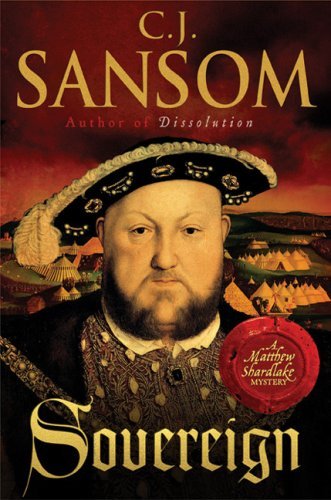
In the spring of 1541, Henry VIII faced another conspiracy in the north of England. The people and nobles in that region were largely opposed to the 'new religion' and still loyal to Rome. The conspiracy was uncovered, and many of its leaders were imprisoned and executed. In response, Henry and his advisers quickly organized a grand Progress, setting out to York in July to consolidate his authority. This forms the backdrop to the third of C. J. Sansom's Matthew Shardlake mysteries, SOVEREIGN.
The hump-backed barrister of Lincoln's Inn, London, is summoned by Archbishop Cranmer and given a task to help bring petitions for justice from the people to the king in York. Additionally, Cranmer instructs him to ensure the safety of a noble prisoner, a conspirator, who is being transported from York to London to face torture in the Tower. The story begins as Shardlake and his assistant, Jack Barak, arrive in York a few days before the King's Progress. What unfolds is a tale filled with period-specific details, suspense, danger, and political intrigue set in the tumultuous times of Henry's England. A suspicious death, enigmatic last words, a container of secret documents, multiple attempts on Shardlake's life, and his ongoing legal dispute with a formidable adversary, Sir Richard Rich of the King's Privy Council, thrust the lawyer into events larger than he can comprehend, including the tragic fate of Queen Catherine Howard.
Readers who have enjoyed the first two books in this series, "Dissolution" and "Dark Fire," have come to anticipate a genuine portrayal of the intense and perilous atmosphere of early reformation England by Sansom. They will not be disappointed. Sansom has a talent for bringing the characters and the historical period to life, almost making us feel like we are right there. Those who are new to Sansom's work are in for a delightful experience.
War of the Wolf by Bernard Cornwell

Mr. Cornwell consistently captivates readers with his engaging and unpredictable storytelling in the latest installment of the Uhtred series. The narrative keeps you on the edge of your seat as unexpected twists and turns defy any anticipated progression of events.
In "War of the Wolf", Uhtred is older, wiser, and more cunning, but occasionally a little careless. He has also become somewhat more superstitious than he was years before. If anything, the Uhtred character is now even more seasoned, experienced, worldly-wise, and perhaps weary of the world.
But Uhtred is still very full of fire, and determination, and with an expert, well-honed, innate knowledge of battle-craft. If you have liked the preceding Uhtred stories, you will be very comfortable with this new book -- and perhaps a little surprised.
Dictator by Robert Harris

Robert Harris' Marcus Tullius Cicero trilogy is a fictional account of Cicero's life written by his famous aide and secretary, Tiro. Tiro was Cicero's indispensable assistant throughout his career, and while he did write a biography, it was lost when the Roman Empire fell. Harris seeks to recreate this work based on historical sources, closely adhering to the historical record. It's safe to say that if we had Tiro's actual work, it would be very similar to this fine, well-written, and engrossing series of novels.
In this third novel, we follow Cicero's life from just before Julius Caesar seizes power in Rome to first Caesar's, and then Cicero's death. Historians and Rome enthusiasts have always been fascinated by this period in history, during which the ancient Roman Republic finally succumbs to the one-man rule that Roman politics had vehemently opposed for centuries.
Different authors and historians have described Cicero's role during this time in various ways. Some have seen him as ineffective, self-centered, and vain, while others, as in this novel, view him as an idealist seeking to preserve the Roman Republic. Harris's portrayal of Cicero depicts him as hardworking and tough-minded, with a harsh judgment of stupidity, and dedicated to preserving the Republic. This novel seems to offer a more accurate perspective on Cicero than many other authors have presented.
Most importantly, this novel, like Harris' entire series, is highly readable and engrossing. It provides excellent entertainment and is a wonderful read.
Month of March: Best of Quotes


